Best Intercom Alternatives for E-Commerce and SMB Teams
Discover the best Intercom alternatives for e-commerce and SMB teams. Explore top options like Ernest and Gorgias for cost-effective support solutions.

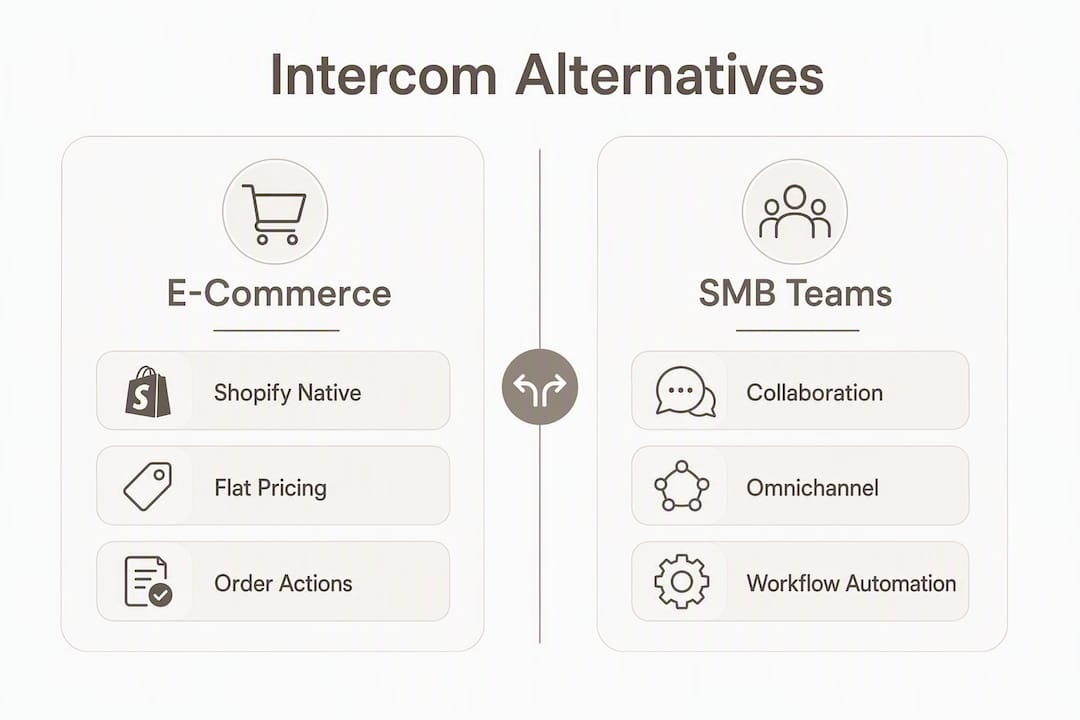
If you're running a Shopify store or a small SaaS team and your Intercom bill just jumped again, here's the short answer: Ernest is the strongest pick for e-commerce teams who need Shopify order actions and predictable AI pricing. Gorgias is the closest native competitor for Shopify merchants who want a helpdesk-first approach. Help Scout is the go-to for small teams that just want a clean, flat-rate shared inbox.
Here's the quick shortlist mapped to the most common reasons teams switch:
- Ernest — Best for Shopify merchants who want AI that handles order status, returns, and cancellations automatically, with transparent pricing that includes AI across every tier.
- Gorgias — Best for e-commerce teams that need order management built directly into the helpdesk conversation view.
- Help Scout — Best for small teams that want email-style support with flat, predictable billing and fast onboarding.
- Front — Best for B2B teams that need shared inboxes, internal @mentions, and complex routing across departments.
- Zendesk — Best for larger support teams that need structured ticketing, SLA enforcement, and a wide integration library.
- Freshdesk — Best for budget-conscious teams that want a free entry tier and a clear upgrade path.
- Kustomer — Best for organizations that need a unified customer profile across every channel and a longer conversation history.
- Drift — Best for sales-led teams that use chat primarily for lead qualification and meeting scheduling.
- Re:amaze — Best for ecommerce stores that want messaging, basic order workflows, and embedded FAQs in one place.
- Tidio — Best for small stores that need live chat and simple chatbots up and running in under an hour.
The single most common reason SMB e-commerce teams leave Intercom is billing unpredictability. Per-resolution AI fees and layered add-ons make it nearly impossible to forecast your monthly cost as order volume grows.
Table of Contents
- Why do teams switch from Intercom?
- How we picked and compared these alternatives
- The best Intercom alternatives compared head-to-head
- Pricing compared: what you'll actually pay
- How do you choose the right Intercom alternative?
- Migration checklist: moving from Intercom without losing context
- Why Ernest works especially well for e-commerce teams
- Key Takeaways
- The part most teams get wrong when switching from Intercom
- Ernest is built for e-commerce teams who are done guessing at their bill
Why do teams switch from Intercom?
The honest answer: it's rarely one thing. Most teams hit a combination of problems at once.

Billing unpredictability is the most cited driver. Intercom's pricing model layers seat costs, AI resolution fees, and add-ons in ways that make the monthly bill hard to forecast. A store running a seasonal promotion can see costs spike without warning.
Per-interaction AI fees are a specific version of that problem. Some platforms charge based on each conversation the AI handles; for example, platforms like Ada may charge around $1–$3.50 per interaction. That model works fine at low volume and becomes painful fast as your store scales.
Limited e-commerce context is the third major complaint. Intercom is a general-purpose platform. It doesn't natively pull order history, trigger cancellations, or initiate returns from inside the chat window. For a Shopify merchant, that means agents are constantly tab-switching.
Here's what teams actually want when they start looking for alternatives:
- Flat or workspace-based pricing that doesn't spike with AI usage
- Native Shopify order actions (cancel, refund, return) from inside the conversation
- Omnichannel ticketing that covers chat, email, and social without expensive add-ons
- AI that reads your actual FAQs, policies, and product catalog, not just generic prompts
- Faster setup and migration with less admin overhead
Three buyer profiles show up repeatedly:
A solo founder running a Shopify store cares almost entirely about cost predictability and automation. They don't have a support team. They need AI to handle order status and returns at 2 AM without a human in the loop.
A growth-stage SaaS team of 5–10 agents cares about routing, internal collaboration, and AI that can be trained on product documentation. Billing predictability matters, but so does the ability to escalate complex tickets cleanly.
A mid-market e-commerce brand with 20+ agents needs omnichannel coverage, SLA enforcement, and deep Shopify integration. They're often the ones most burned by per-resolution fees because their ticket volume is high enough to make those fees sting.
Pro Tip: Before you book a single demo, write down your #1 pain point in one sentence. "Our Intercom bill is unpredictable" leads to a different shortlist than "our agents can't see order history in chat." That sentence will save you three weeks of evaluation time.
How we picked and compared these alternatives
Every tool on this list was evaluated against the same set of criteria, in this order:
- Pricing model clarity — Can you predict your bill 3 months from now? Is AI included or metered separately?
- AI capability and context depth — Does the AI read your actual product data and policies, or does it rely on generic prompt templates?
- Shopify and e-commerce integrations — Can it surface order history and trigger order actions from inside the conversation?
- Channels supported — Chat, email, voice, social: which are native vs. add-on?
- Migration speed — How long does a realistic migration take for a 5-agent team?
- Internal collaboration — Shared inboxes, @mentions, assignment rules, escalation paths.
- Scale — Does the platform hold up at 50 agents, or does it get expensive and clunky?
Vendor docs, public pricing pages, independent review platforms like G2, and hands-on product testing all fed into these evaluations. Where pricing is not publicly listed, that's noted.
That framing shapes this entire article. Pick the category that matches your primary pain point, vet two or three tools from that category, and run a two-week pilot before committing.
The best Intercom alternatives compared head-to-head
The comparison table
| Tool | Best for | Pricing model & entry | Channels | AI / bot capabilities | Shopify / e-commerce | Scale | Setup ease | Free tier / trial |
|---|---|---|---|---|---|---|---|---|
| Ernest | Shopify merchants needing AI order actions | Conversation-volume tiers; AI included on all plans | Chat, email escalation | Ingests FAQs, policies, product data; triggers order actions | Native Shopify; order cancel and return; refunds with merchant approval | SMB | Fast; ingests store data quickly | Free plan available |
| Gorgias | Shopify merchants wanting helpdesk-first order management | Ticket-volume tiers | Chat, email, social, voice | Rule-based automations; AI assist | Deep Shopify native; order actions in conversation | SMB to mid-market | Moderate | 7-day trial |
| Help Scout | Small teams wanting flat-rate email-style support | Per-seat or workspace flat rate | Email, chat, docs | Basic AI drafts; limited bot depth | Limited native; via integrations | SMB | Very fast | Free trial |
| Front | B2B teams needing collaboration and routing | Per-seat | Email, chat, SMS, voice | AI drafts; rule-based routing | Via integrations | SMB to enterprise | Moderate | Free trial |
| Zendesk | Large teams needing ticketing and SLAs | Per-seat | Chat, email, voice, social | AI assist; broad bot options | Via integrations and marketplace | Mid-market to enterprise | Complex | 14-day trial |
| Freshdesk | Budget-conscious teams scaling from free | Per-seat; free tier available | Chat, email, phone, social | Freddy AI; tiered access | Via integrations | SMB to mid-market | Fast | Free plan |
| Kustomer | Teams needing unified customer profiles | Per-seat | Chat, email, voice, social | AI assist; workflow automation | Via integrations | Mid-market | Moderate | Demo-based |
| Drift | Sales teams using chat for lead qualification | Per-seat; pricing not public | Chat, email | Conversational AI; meeting scheduling | Limited | SMB to enterprise | Moderate | Demo-based |
| Re:amaze | Ecommerce stores wanting messaging plus basic order workflows | Per-seat or flat-team plans | Chat, email, social, voice | Basic bots; FAQ widgets | Shopify integration; basic order data | SMB | Fast | 14-day trial |
| Tidio | Small stores needing fast live chat setup | Freemium; per-seat paid tiers | Chat, email | Lyro AI chatbot | Shopify plugin | Small business | Very fast | Free plan |

Per-product profiles
Ernest connects directly to Shopify and ingests your FAQs, return policies, and product catalog on setup. From inside the chat window, it can cancel an order, start a return, or check shipping status without a human agent touching the ticket. AI is included across all pricing tiers, so your bill scales with conversation volume, not with how many tickets the AI resolves. For a solo founder or a small Shopify team, that's a fundamentally different cost structure than most alternatives.
Pros: AI included on all plans; native Shopify order actions; fast store data ingestion; 24/7 coverage with human escalation. Cons: Primarily chat-focused; best fit is e-commerce rather than general SaaS support.
Gorgias is the other genuinely Shopify-native option. It surfaces order history inside every conversation and lets agents trigger refunds or cancellations without leaving the helpdesk. Independent roundups consistently recommend it for Shopify merchants because the order-centric workflow is built in, not bolted on. The pricing model is ticket-volume based, which can get expensive during high-traffic periods like Black Friday.
Pros: Deep Shopify integration; order actions in conversation; multichannel native. Cons: Ticket-volume pricing spikes during promotions; AI features are less context-rich than dedicated AI agents.
Help Scout is the predictable billing option for teams that don't need Shopify order actions. Its shared inbox mirrors email workflows, so adoption is fast. The AI drafting features are useful but not deep. If your team's primary pain is Intercom's billing complexity and your support is mostly email-based, Help Scout is a clean, low-drama switch.
Pros: Flat/workspace pricing; fast adoption; clean shared inbox. Cons: Limited e-commerce order actions; AI depth is basic compared to dedicated AI agents.
Front is built for teams where support and sales overlap, or where tickets need to move across departments with full context. The @mention system and assignment rules are genuinely strong. It's a better fit for B2B SaaS teams than for e-commerce. Per-seat pricing can add up quickly for larger teams.
Pros: Strong internal collaboration; advanced routing; omnichannel. Cons: Per-seat pricing; limited native e-commerce integrations.
Zendesk is the enterprise standard for a reason. Its ticketing system, SLA enforcement, and integration library are the deepest on this list. G2 reviewers note that the platform handles complex routing and reporting well at scale. The tradeoff is setup complexity and cost. For a 5-agent Shopify store, it's almost certainly more platform than you need.
Pros: Robust ticketing; SLA enforcement; massive integration ecosystem. Cons: Complex setup; per-seat pricing at scale; not e-commerce native.
Freshdesk earns its place as the budget-friendly path. The free tier is genuinely functional, and the upgrade path to structured ticketing is clear. Freddy AI is included at higher tiers. For teams that are outgrowing a shared Gmail inbox but aren't ready to commit to a paid platform, Freshdesk is a low-risk starting point.
Pros: Free plan; clear upgrade path; multichannel. Cons: AI features are tier-gated; Shopify integration is via third-party connectors.
Kustomer centers everything on the customer profile. Every conversation, order, and interaction lives on a single timeline. That's powerful for teams handling complex, multi-touch customer relationships. It's less useful for stores where most tickets are transactional (order status, returns) and can be resolved in one exchange.
Pros: Unified customer timeline; strong workflow automation; omnichannel. Cons: Higher price point; overkill for simple transactional support.
Drift (now part of Salesloft) is a conversational marketing platform first, a support tool second. If your team uses chat primarily to qualify leads and book meetings, Drift's intent-driven workflows and meeting scheduling integrations are genuinely useful. For pure customer support, it's not the right fit.
Pros: Strong lead qualification; meeting scheduling; AI conversation flows. Cons: Not built for support-first workflows; pricing not publicly listed.
Re:amaze sits between a helpdesk and a CRM for small ecommerce stores. It combines chat, email, and social messaging with basic order data from Shopify and embedded FAQ widgets. It's not as deep as Gorgias on order actions, but it's more affordable and easier to set up for a small team.
Pros: Integrated messaging; basic Shopify order data; affordable team plans. Cons: AI capabilities are limited; order actions less robust than Gorgias or Ernest.
Tidio is the fastest path to live chat for a small store. The Lyro AI chatbot handles basic FAQs, and the Shopify plugin installs quickly. It's not built for complex support workflows, but for a store owner who just needs chat coverage and simple automation, it's hard to beat on setup speed.
Pros: Very fast setup; free plan; Lyro AI for basic FAQs. Cons: Limited depth for growing teams; AI context is shallow compared to purpose-built agents.
Pro Tip: When evaluating AI capabilities, send 10 real support tickets from your last 30 days through each platform's demo or trial. Generic AI responses that don't reference your actual policies or product names are a red flag at any price point. AI that reads deep context handles brand voice far better than template-based agents as volume grows.
Pricing compared: what you'll actually pay
Pricing models across these platforms fall into four categories, and the category matters more than the entry price.
| Tool | Pricing model | Entry price (approx.) | AI included? | Free tier? |
|---|---|---|---|---|
| Ernest | Conversation-volume tiers | Free plan available | Yes, all tiers | Yes |
| Gorgias | Ticket-volume tiers | ~$10/month (50 tickets) | Add-on | 7-day trial |
| Help Scout | Per-seat or workspace | ~$20/seat/month | Basic; tier-gated | Trial only |
| Front | Per-seat | ~$19/seat/month | Tier-gated | Trial only |
| Zendesk | Per-seat | ~$55/seat/month | Add-on / tier-gated | 14-day trial |
| Freshdesk | Per-seat | Free tier; ~$15/seat paid | Freddy AI; tier-gated | Yes |
| Kustomer | Per-seat | Not publicly listed | Tier-gated | Demo only |
| Drift | Per-seat | Not publicly listed | Included | Demo only |
| Re:amaze | Per-seat or flat team | ~$29/seat/month | Basic | 14-day trial |
| Tidio | Freemium | Free; paid tiers from ~$29/month | Lyro AI; tier-gated | Yes |
Three scenarios that show how costs diverge
-
Solo Shopify founder with low monthly support volume. On a conversation-volume model like Ernest's, you may stay on a free or low-cost tier. On a per-seat model, you pay the minimum seat fee regardless of volume. On a ticket-volume model like Gorgias, ticket volume increases can bump you to higher pricing tiers.
-
Small teams with moderate ticket volume. Per-seat platforms may run higher monthly costs before AI add-ons. Some options offer more predictable workspace pricing at this size. Pricing differences between platforms can be significant.
-
Larger teams with high conversation volume. Per-resolution AI fees can significantly impact total cost, potentially adding substantial fees on top of seat costs.
Red flags to watch for in vendor contracts:
- Per-resolution or per-interaction AI fees that aren't capped
- Minimum seat commitments that lock you in before you've validated fit
- Mandatory add-ons for features that competitors include by default (voice, social, AI)
- Integration charges for connecting Shopify or your CRM
- Annual-only billing with no monthly option during the trial period
Flat-fee or workspace pricing tends to be more sustainable for small-to-mid teams than per-resolution models that scale unpredictably with volume.
How do you choose the right Intercom alternative?
Start with one question: What's my #1 pain point right now? Billing unpredictability, missing Shopify order actions, and weak internal collaboration lead to completely different shortlists.
Decision checklist
- Billing predictability — Can you model your worst month in advance? Per-resolution and per-seat AI fees make that hard; flat conversation tiers make it easy.
- Shopify depth — Does the AI just answer questions, or can it look up orders and act on them? Order actions are where deflection actually saves time.
- AI included vs. AI as an add-on — If the AI you're evaluating costs extra, price the bundle, not the base plan.
- Collaboration and routing — Do tickets need to move across teams with full context? Front and Zendesk are stronger here than most e-commerce-native tools.
Questions to ask during a vendor demo
- "Show me exactly how AI is priced. Is it per seat, per conversation, or per resolution?"
- "Can the AI be trained on our specific return policy and product catalog? Show me that in the demo."
- "What happens to our Intercom conversation history during migration? Can you import it?"
- "If we need to cancel a Shopify order from inside a chat, walk me through exactly how that works."
- "What's your SLA for support response if we have a platform outage?"
- "Is there a minimum contract length, and what's the exit process?"
Red flag answers that should end the conversation:
- "AI pricing is based on resolutions, and we'll true up at the end of the month" (unpredictable billing)
- "You can export data, but we don't assist with migration" (high switching cost)
- "Shopify integration is available via Zapier" (not native; fragile)
- "Our AI uses your knowledge base, but it doesn't connect to live order data" (not useful for e-commerce)
Migration checklist: moving from Intercom without losing context
A clean migration takes planning, not just a data export. Here's a realistic step-by-step process.
- Export all conversation history and user data from Intercom before you cancel. Download contacts, conversation threads, and any custom attributes. Most platforms accept CSV imports.
- Map your existing automations and tags. List every Intercom rule, bot flow, and tag. Recreate the critical ones in your new platform before go-live.
- Preserve message history. Check whether your new platform can import Intercom conversation exports. If not, archive them externally so agents can reference past context.
- Set up parallel routing for 1–2 weeks. Run both platforms simultaneously during the pilot. New conversations go to the new platform; complex in-flight tickets finish in Intercom.
- Run a pilot with a subset of tickets. Pick 10–20% of your volume and route it through the new platform for two weeks. Measure resolution time, escalation rate, and agent feedback.
- Train your team on the new interface. Platforms that mirror shared-inbox workflows (Help Scout, Re:amaze) have faster adoption curves. Zendesk and Kustomer take longer.
- Set rollback triggers before go-live. Define the conditions that would send you back to Intercom: resolution time doubles, escalation rate spikes above X%, or a critical integration breaks.
Timeline estimates:
- 1–5 agents, simple workflows: 1–2 weeks from export to full cutover.
- 10–50 agents, complex automations: 4–6 weeks, including a 2-week parallel pilot.
For ecommerce-specific support migrations, the most commonly missed step is remapping order action workflows. If your current setup triggers refunds or cancellations via Intercom automations, those need to be rebuilt in the new platform before you cut over, not after.
Why Ernest works especially well for e-commerce teams
Ernest is built for exactly the buyer profile that most Intercom alternatives miss: the Shopify merchant or small e-commerce brand that needs AI to handle the full support loop, not just answer FAQs.
Here's what that looks like in practice:
- Shopify order actions from chat. Ernest connects to your Shopify store and can cancel an order, initiate a return, or check shipping status directly from the conversation. No tab-switching, no manual lookup.
- Store data ingestion on setup. Upload your FAQs, return policy, and product catalog, and Ernest's AI is trained on your actual content within minutes. It doesn't rely on generic prompt templates.
- 24/7 coverage with human escalation. When a ticket is too complex for AI, Ernest hands it off to a human agent with full conversation context already attached.
- Transparent pricing with AI included. Every pricing tier includes AI functionality. There are no per-resolution fees that spike your bill during a busy week.
- Multi-language support. Ernest handles customer inquiries in multiple languages, which matters for stores with international customers.
The pricing structure is designed so a solo founder can start on a free plan and scale without hitting a billing cliff.
For teams evaluating customer service software for small businesses, Ernest's combination of Shopify-native order actions and flat AI pricing puts it in a different category than general-purpose helpdesks.
Key Takeaways
The strongest Intercom alternative for most SMB e-commerce teams is one that includes AI in its base pricing, connects natively to Shopify, and lets you predict your monthly bill without a spreadsheet.
| Point | Details |
|---|---|
| Billing model is the first filter | Per-resolution AI fees can be unpredictable; eliminate vendors with uncapped usage billing early. |
| E-commerce order actions narrow the shortlist | Only Ernest, Gorgias, and Re:amaze handle Shopify order actions natively inside the conversation. |
| Run a pilot before committing | A 2-week parallel pilot with real tickets reveals fit faster than any demo or feature comparison. |
| Migration takes longer than expected | Teams with a moderate number of agents should budget several weeks for migration, including automation remapping and a parallel routing period. |
| Ernest for Shopify teams | Ernest includes AI on all plans with native Shopify order actions and conversation-volume pricing, making it the most predictable option for e-commerce teams. |
The part most teams get wrong when switching from Intercom
Most teams spend most of their evaluation time on features rather than pricing structure. It should be the other way around.
Here's the thing: nearly every platform on this list can handle your support tickets. The features are close enough that you won't feel a dramatic difference in day-to-day use. What you will feel, six months in, is the billing model. A per-resolution AI fee that looked manageable at 500 tickets a month becomes a real problem at 3,000. A per-seat model that seemed fine with 5 agents gets painful when you hire three more during peak season.
The second mistake is skipping the pilot. Teams commit to a platform after a polished demo and then discover, three weeks into the migration, that the AI doesn't actually read their return policy, or that the Shopify integration only surfaces order data but can't trigger actions. A two-week pilot with real tickets from your actual queue catches those gaps before you've canceled Intercom and burned the bridge.
One practical tip: before you start any demo, pull 10 real support tickets from the last 30 days. Use those exact tickets to test every platform's AI. If the AI gives you a generic response that could apply to any store, that's your answer. If it references your specific policy and offers to take action on the order, that's the platform worth your time.
Ernest is built for e-commerce teams who are done guessing at their bill
If the comparison above confirmed what you already suspected, the next step is straightforward. Ernest provides Shopify merchants AI-powered support that handles order status, returns, and cancellations automatically, with pricing that scales by conversation volume, not by how many tickets the AI resolves.
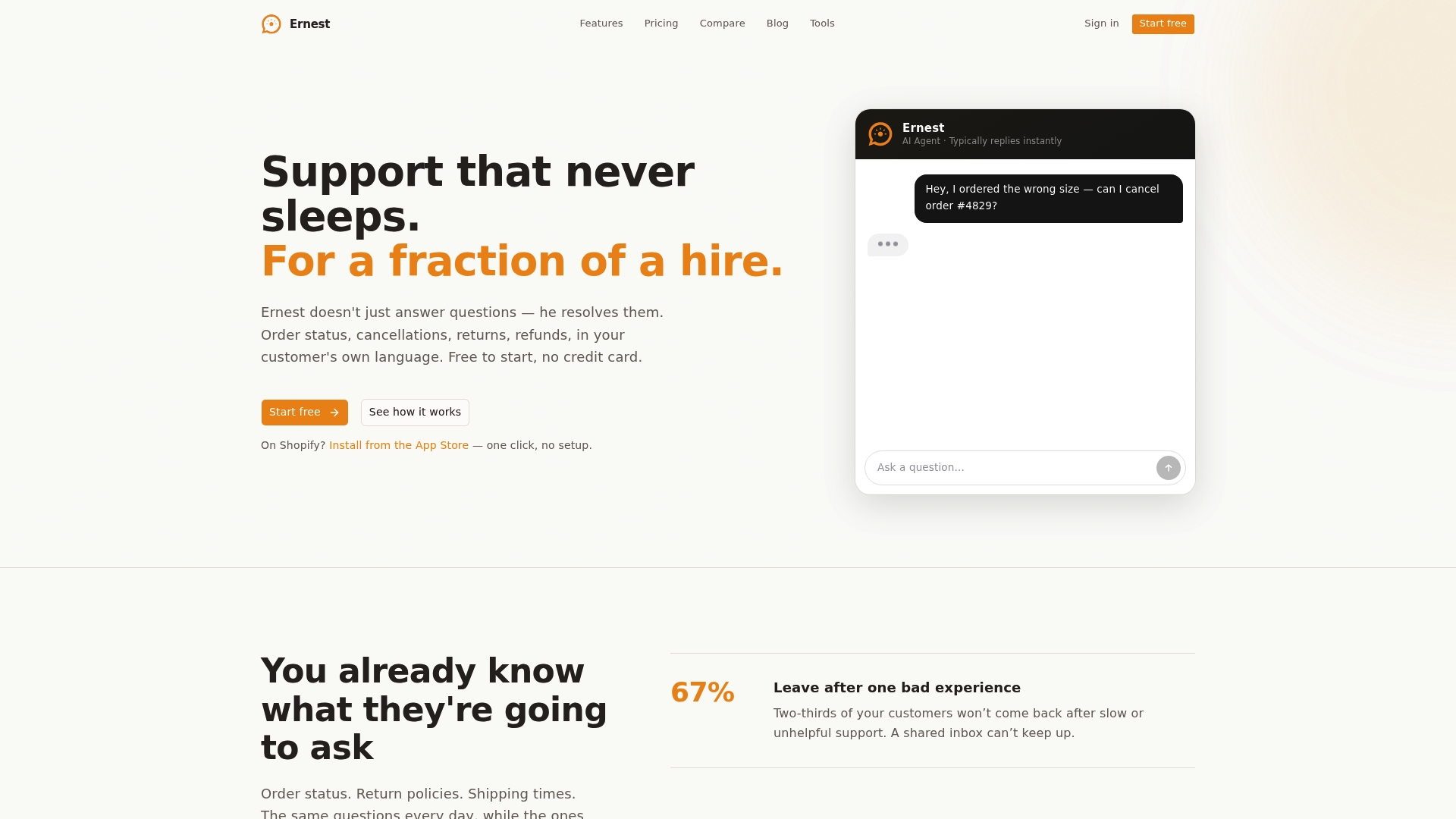
There's a free plan to start, no credit card required, and setup takes minutes rather than weeks.
Start on the free plan at heyernest.ai and connect your Shopify store. Ernest ingests your FAQs and policies on setup, so your first real customer interaction is covered from day one.
Recommended
- Best Zendesk Alternatives for E-Commerce AI Chat in 2026 | Ernest Blog
- Best Customer Service Software for Small Business in 2026: A No-Fluff Comparison | Ernest Blog
- Best Customer Service Chatbots for E-Commerce in 2026 | Ernest Blog
- Ecommerce Customer Service: What Small Stores Get Wrong (and How to Fix It) | Ernest Blog