Best Customer Service Chatbots for E-Commerce in 2026
The best customer service chatbot for your store depends on pricing model and order automation. We compare Ernest, Gorgias, Intercom Fin, Zendesk and Tidio

Most "best customer service chatbot" roundups rank tools by feature count, which tells you almost nothing about how one will behave in your inbox. For an online store, a single question sorts the field faster: can the bot cancel an order, or can it only recite your cancellation policy back to the customer?
That distinction matters because of what your queue is made of. Order-status questions ("where is my order?") run somewhere between a quarter and half of inbound support volume for most e-commerce brands, climbing higher during peak weeks, according to Salesforce's WISMO breakdown. A bot that answers questions deflects the easy half of that. A bot that takes actions clears it.
The shortlist, sorted by who it's for
- Ernest: Shopify and WooCommerce stores that need order status, returns and cancellations handled autonomously, with refunds held for your approval.
- Gorgias: e-commerce brands that want live order data inside every ticket and a large agent team working those tickets.
- Intercom Fin: SaaS and mid-market teams that want per-resolution billing and deep CRM sync.
- Zendesk AI Agents: teams already committed to Zendesk who want an AI layer on an existing helpdesk.
- Tidio and Lyro: small stores that want live chat plus a starter AI bot on one cheap bill.
- Ada: enterprise brands with compliance review, 50+ language requirements, and a team to configure it.
- eDesk: sellers whose volume is split across Amazon, eBay, Walmart and their own store.
- ManyChat: stores where the support conversation happens in Instagram and Facebook DMs.
Everything below is about picking between them.
How the best customer service chatbots compare
| Tool | Best for | Pricing model | Takes order actions | Setup |
|---|---|---|---|---|
| Ernest | Shopify/WooCommerce stores | Free tier, then $49–$299/mo by conversation volume | Yes (status, returns, cancellations) | Minutes |
| Gorgias | Brands with an agent team | $10–$900/mo ticket tiers, ~$1.00 per AI resolution | Yes | Days |
| Intercom Fin | SaaS, mid-market | $0.99 per resolution, seats from $29/mo | Via custom actions | Days |
| Zendesk AI Agents | Existing Zendesk teams | Suite from $55/agent/mo, plus ~$1.50–$2 per AI resolution | Via custom actions | Weeks |
| Tidio / Lyro | Small stores, tight budget | Free tier, Lyro from $39/mo for 50 AI conversations | No | Minutes |
| Freshdesk / Freshchat | Growing mid-market teams | Tiered per agent | Limited | Days |
| Ada | Enterprise, regulated | Custom quote | Via custom actions | Weeks |
| Zowie | Stores with big ticket history | Custom quote | Yes | Days |
| eDesk | Multi-marketplace sellers | Tiered | Marketplace-native | Days |
| ManyChat | Social commerce | Free tier, then tiered | No | Minutes |
Pricing verified against vendor pages in July 2026. AI features are billed separately from base seats at Zendesk, Gorgias and Tidio, so the headline number is rarely what you pay.
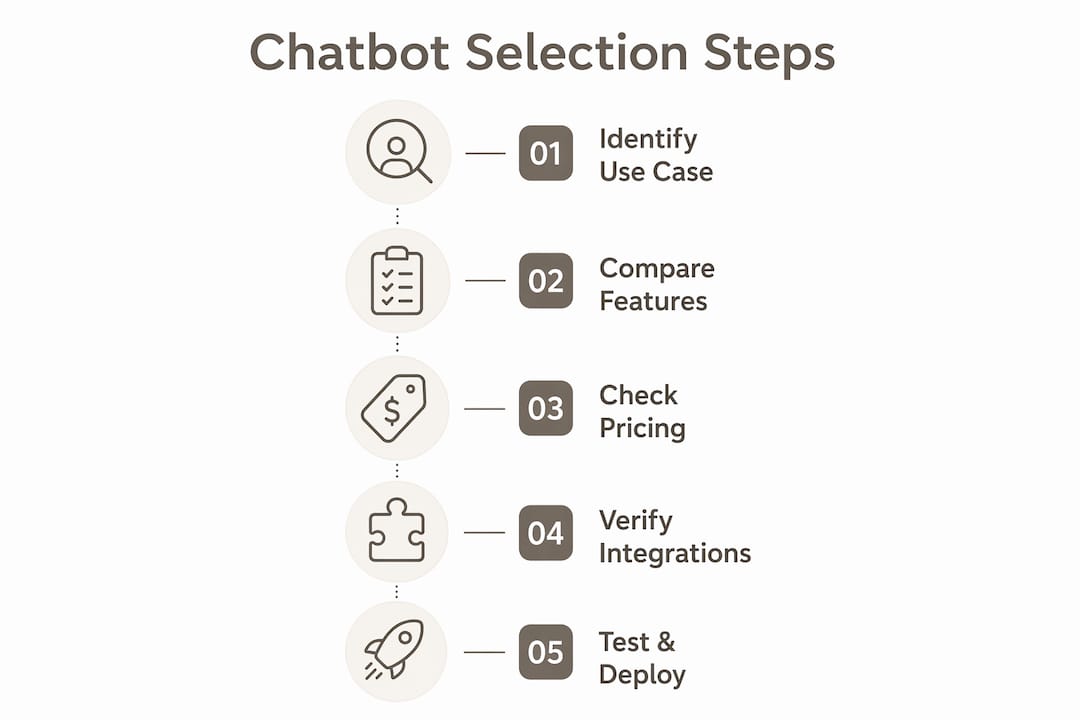
What a customer service chatbot costs in 2026
Three pricing models dominate, and they fail in different ways.
Per resolution. Intercom charges $0.99 every time Fin resolves a conversation, and Zendesk's AI agents run roughly $1.50 to $2 per automated resolution depending on whether you commit to volume. The pitch is that you only pay for outcomes. The trap is the definition of "resolved," which each vendor writes themselves. Intercom counts a conversation where Fin answered and the customer left without asking again. Ask for that definition in writing before you sign.
Per ticket. Gorgias sells ticket bands from $10 to $900 a month with overages around $0.32 to $0.40 once you blow past your tier. A conversation the AI fully resolves can be billed twice, once as a ticket and once as an AI resolution. Model your November volume, not your February volume.
Per seat. Zendesk Suite starts at $55 per agent per month and Freshdesk works similarly. Fine for a stable team. Punishing if you staff up for Q4, because every seasonal hire is a line item, and the AI resolutions are metered on top of the seats anyway.
Then there is conversation-volume pricing, which is what we do at Ernest: a tier buys a number of conversations, AI included, with no seat charges and no per-resolution meter. The free tier is 100 conversations that never expire. Tidio's free tier is real too, though Lyro, the AI layer, starts at $39/mo for 50 AI conversations and bills separately from the chat product.
The contract terms worth negotiating are less exciting than the price: a 30-day cancellation window on any pilot, written overage rates, and data portability. Confirm you can export your bot's training content if you leave.
Which AI chatbot for customer service fits your store
Answer three things before you book a demo.
- What is your queue actually made of? Pull last month's tickets and sort them. If order status, returns and cancellations are the top three, you need action automation and the general platforms are overhead. If your volume is pre-sales and product questions, a knowledge-base bot is enough.
- What is your monthly conversation volume, and what containment rate would justify the spend? Without those two numbers, every vendor demo is persuasive and none of them are comparable.
- Which integration is non-negotiable? A bot without a native connector to your order system will need a developer and a webhook, and that project never takes the two weeks it's scoped at.
Questions that separate vendors in a demo
- What counts as a resolved conversation in your billing, precisely?
- Show me the escalation flow when the bot cannot answer. Does the agent get the full context or a transcript dump?
- What happens when the bot is confident and wrong? Show me the guardrail.
- Can I export my training data if I cancel?
- What data do you retain about my customers, and for how long?
Red flags: a vendor who won't run a demo on your own catalog and return policy, escalation logic nobody can explain, a 12-month commitment demanded before a pilot, and security documentation that isn't available on request. Ask for SOC 2 compliance documentation in writing before any tool touches customer PII.
The cleanest pilot design is two weeks on your top three query types with a containment target you set in advance. If the bot can't hold your top three, it won't hold the tail. It's also worth deciding upfront what your handoff to a human should look like, because that flow is where most deployments quietly lose customers.
What deployment looks like
A small store can be live in one to two weeks. An enterprise rollout across channels and departments takes two to four months, and most of that is not technical.
| Phase | Timeline | What happens |
|---|---|---|
| Ingestion | Days 1–3 | Return policy, shipping FAQ, product pages, order system connected |
| Configuration | Days 3–7 | Escalation rules, tone, integrations |
| Testing and soft launch | Days 7–10 | Sample queries, edge cases, then 10% of live traffic |
| Full launch | Week 3+ | Full traffic, iterate on low-confidence responses |

Track containment rate and escalation rate from day one, but track the reason for each escalation rather than the count. That list is your training backlog. Spot-check a sample of resolved conversations weekly, because a confident wrong answer costs more than an escalation and it will not show up in your containment number.
Most pilots stall in ingestion. Get your return policy, shipping FAQ and top 20 product questions in before launch and skip everything else. That content covers the majority of e-commerce volume on its own, which is the same reason a well-built FAQ page reduces ticket count before any bot is involved.
Why a specialist usually beats a general platform
The common mistake is starting with the biggest brand you recognize. Two weeks into a Zendesk or Intercom trial, you find the bot answers questions well and still cannot cancel an order without a developer wiring up a custom action. That gap is where the frustration lives.
General platforms are built for breadth: support across departments, channels, billing, technical tiers. Genuinely valuable at 50 agents across three functions. Mostly overhead for a Shopify store where the top three ticket types are all order-related.
We built Ernest narrow on purpose. It connects to Shopify or WooCommerce, ingests your policies and product data, and handles order status, return initiation and cancellation requests on its own, around the clock. Refunds are held for your approval rather than issued automatically, which is the one place we think full autonomy is a bad idea. Escalations arrive with the whole conversation attached. Pricing is per conversation, so a seasonal hire doesn't change your bill.
The honest version of the recommendation: if you're running multi-department support with complex routing and compliance review, buy the general platform with a strong AI layer. If your queue is order-centric and you need the bot to do things, start with a specialist. And if you're planning to go from 5 agents to 50 in eighteen months, weigh that trajectory now, because the tool that fits at $200 a month may not fit that operation. Our comparison of customer service software for small businesses goes deeper on where each tier stops making sense.
Start with the queue you already have
Export last month's tickets and count how many are order status, returns and cancellations. If that's more than half, you have a case for action automation, and the broader fixes for small-store support will move faster once those are off your plate.
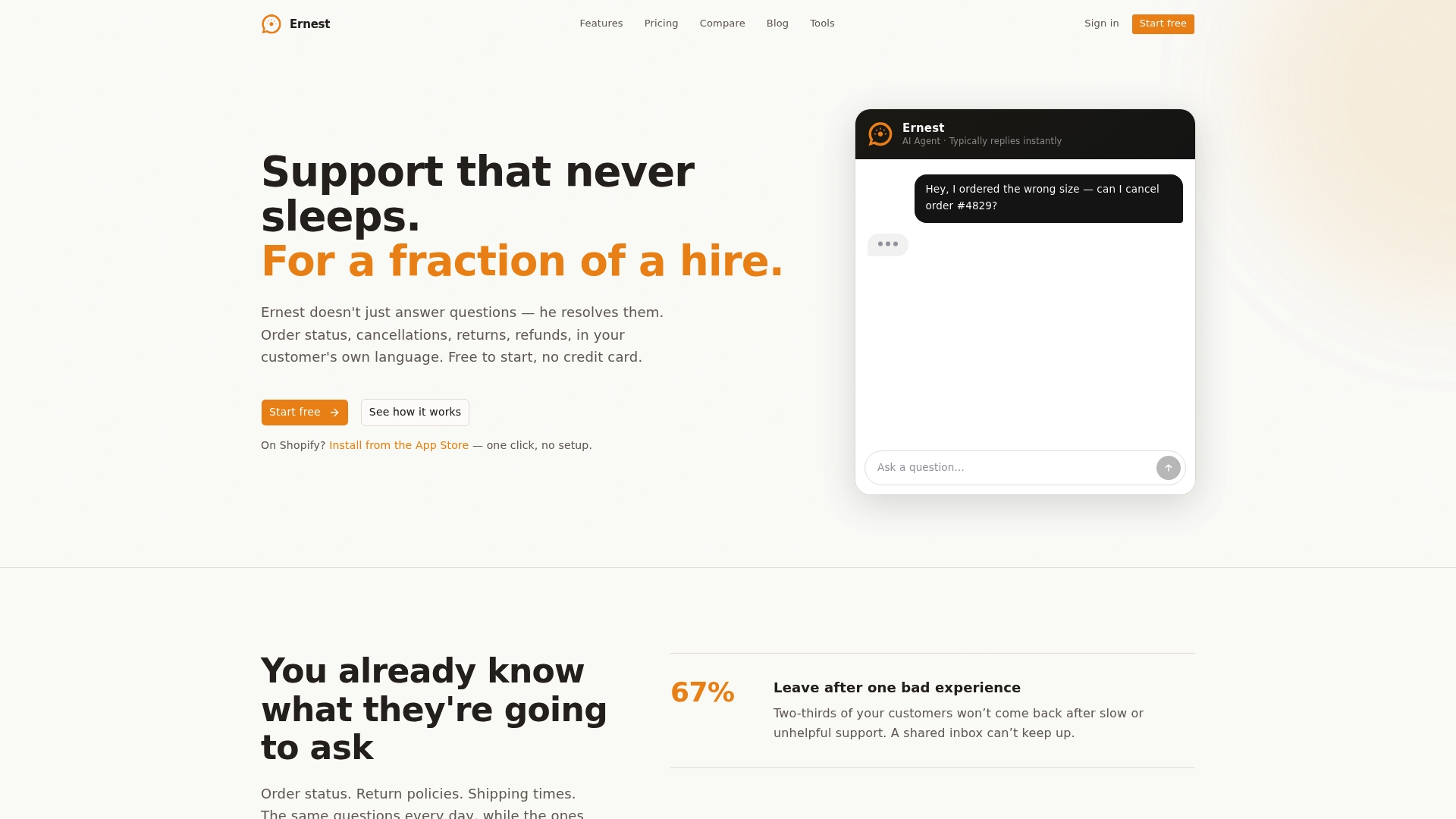
Then test it against real traffic. Ernest's free plan is 100 conversations with no expiry and no card, which is enough to see your actual containment rate rather than a vendor's. Install it from the Shopify App Store or connect a store directly at heyernest.ai, point it at your return policy and shipping FAQ, and watch what it clears in a week. Most stores are live the same day.