Best Zendesk Alternatives for E-Commerce AI Chat in 2026
Zendesk prices per seat and gates AI behind upper tiers. Here are the alternatives that resolve order actions, compared on pricing and AI plan access.

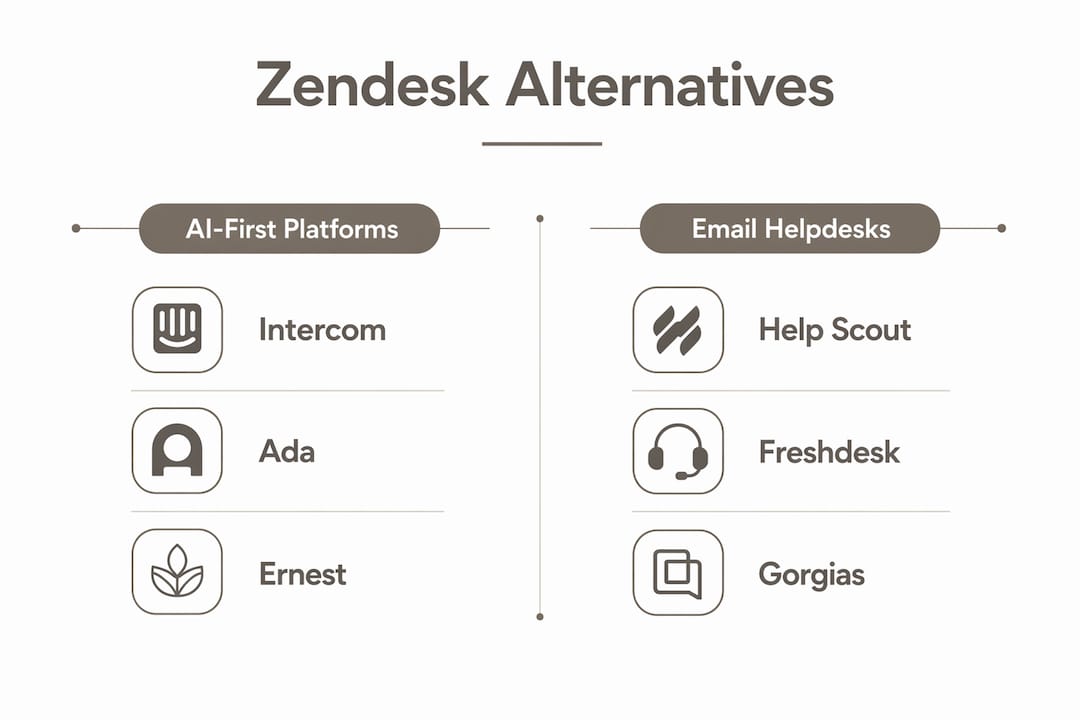
For Shopify stores that need AI chat handling order status, cancellations, and returns around the clock, the shortlist comes down to six options: Ernest, Gorgias, Intercom, Freshdesk, Help Scout, and Ada. Ernest is the recommended pick for most Shopify merchants. It connects directly to your store, automates cancel and return actions, and includes AI across every pricing tier without charging per seat.
Here's why Ernest stands out for order and return automation:
- Shopify integration with action-level access: Ernest doesn't just read order data. It can cancel an order or initiate a return label without routing the customer to a human agent.
- 24/7 AI coverage with clean escalation: When a case is too complex, Ernest hands off to a human agent with full order context intact, so your team never starts from scratch.
- Transparent, tiered pricing with a free plan: AI features aren't locked behind the highest tier. Solo founders and growing teams both get access to the same core automation.
Security and compliance matter too. Ernest's architecture supports GDPR and PCI considerations, which is a real concern when your AI agent is touching order and payment data.
Pro Tip: Before you evaluate any platform, confirm it can perform automated actions (cancel order, create return label) on your specific Shopify plan. Some tools read order data but can't write back to Shopify without a higher-tier API scope.
Table of Contents
- Which Zendesk alternatives actually compare for order and return automation?
- What do these alternatives actually deliver on day one?
- How do you choose the right alternative for your store?
- How long does setup actually take, and what do you need to migrate?
- When does Ernest make sense, and when should you look elsewhere?
- Key Takeaways
- The part of this conversation most tools skip
- Ernest handles order and return chat so your team doesn't have to
- Sources and further reading
Which Zendesk alternatives actually compare for order and return automation?
Shopify integration and app-store listings are among the top decision factors for merchants evaluating help desk software. The table below maps the dimensions that actually matter for e-commerce order and return workflows.
| Dimension | Ernest | AI-First Conversational Platforms | Email/Shared-Inbox Helpdesks | Chat Specialists with Shopify Apps |
|---|---|---|---|---|
| Best for | Shopify stores needing automated order/return actions | Mid-market with complex conversation flows | Teams managing high email volume | Stores wanting rich chat + ticketing |
| Starting price / free tier | Free plan available; tiered paid plans | n/a | Free tiers common | Paid options and some free tiers |
| Shopify integration | Native, action-level | App or API; varies by platform | App available; read-only common | Native app; strong |
| AI for order status / returns | Yes, core feature | Yes, configurable | Limited; rule-based | Yes, with setup |
| Automated actions (cancel, return label) | Yes | Partial; depends on plan | Rarely | Varies by app |
| Human escalation with context | Yes, full order context | Yes | Yes | Yes |
| Setup time | Days | 1–3 weeks | Days to 1 week | 1–2 weeks |
| Trust signals | Shopify App Store, transparent pricing | G2 ratings, case studies | G2/Capterra, case studies | Shopify App Store reviews |
Quick ratings:
- Ernest: Best for automated Shopify actions. Fast setup, AI included at every tier, clean escalation.
- AI-first conversational platforms (e.g., Intercom, Ada): Strong NLP and conversation design. Better fit when you need complex branching flows beyond order/return basics.
- Email/shared-inbox helpdesks (e.g., Help Scout, Freshdesk): Solid for teams managing high email volume. Automated return actions are limited without custom integrations.
- Chat specialists with Shopify apps (e.g., Gorgias): Deep e-commerce context, strong Shopify app. Worth evaluating if your team already lives in a ticketing inbox.
What do these alternatives actually deliver on day one?
Ernest (Heyernest)
Ernest ingests your Shopify store data, FAQs, and return policies in a single setup flow. From day one, it can answer order status questions, trigger cancellations, and start return label creation without a human in the loop. Escalation passes the full order context to your agent inbox, so no customer has to repeat themselves. Pricing is tiered by conversation volume, with AI features included on every plan, including the free tier. Setup typically takes a few days for a standard Shopify store.

AI-first conversational platforms
These platforms (think Intercom or Ada) are built around conversation design and NLP. They handle order and return queries well once configured, but the configuration is the work. Expect one to three weeks to map your order lifecycle events to conversation triggers. Shopify integration exists via app or API, and most offer human handoff. Pricing tends to scale with seat count or conversation volume, and AI features may not be available on entry-level plans.
Email and shared-inbox helpdesks
Help Scout and Freshdesk are natural fits for teams that run support primarily through email. They handle ticket routing, shared inboxes, and basic automation well. Shopify apps exist for both, but automated actions like canceling an order or generating a return label usually require custom workflows or third-party integrations. Setup is fast, often a few days, but the AI layer for order/return automation is thinner than dedicated chat tools.
Chat specialists with native Shopify apps
Gorgias is the clearest example here. It's built specifically for e-commerce and has a strong Shopify app with deep order context. It handles returns and cancellations and gives agents a unified inbox. Setup runs one to two weeks for a full configuration. Pricing is per ticket, which can increase at higher usage. G2 and Shopify App Store reviews are consistently strong.
Pro Tip: To minimize false positives on automated cancellations, map your cancellation trigger to a specific order status window (e.g., only orders placed within the last 30 minutes that haven't shipped). Load anonymized sample orders into a sandbox store and run scripted tests before going live. This one step catches most edge cases before they hit real customers.
How do you choose the right alternative for your store?
The single most important criterion for e-commerce is this: can the tool take a real action on an order, or only respond to a question? Automated actions and clean Shopify sync separate genuinely useful tools from chat widgets with a Shopify logo on the integrations page.
Questions to ask every vendor:
- Can your tool cancel an order or create a return label directly via the Shopify API, without a human step?
- What OAuth scopes does your Shopify app request, and can you show a sample webhook payload for an order event?
- What's your SLA for escalation handoff, and does the agent receive full order context?
- Are AI features available on entry-level plans, or only on higher tiers?
- How do you handle multi-language support for international customers?
Red flags to watch for:
- No Shopify app listed in the Shopify App Store
- Vague descriptions of "return support" with no mention of label creation or refund triggers
- Agent handoff that drops order context and forces the customer to re-explain
- Per-interaction pricing that spikes unpredictably at volume
- GDPR or PCI compliance listed as "coming soon"
Decision matrix by store type:
| Store type | Must-have features |
|---|---|
| Solo founder / small store | Free tier, fast setup, automated cancel/return, no per-seat fees |
| Growing brand (scale-up) | Conversation volume pricing, multi-language, escalation SLAs, analytics |
| Agency managing multiple stores | White-label, multi-account management, transparent per-client pricing |
How long does setup actually take, and what do you need to migrate?
Most cloud-first, SMB-focused tools are usable within days, while enterprise platforms can take weeks and often need a consultant. For a typical Shopify store moving to Ernest or a similar AI-first tool, plan for a rollout within about a month.
Migration checklist:
- Export open tickets and order history from your current platform
- Document your return and cancellation policies in plain text (the AI ingests these directly)
- Generate Shopify API keys and confirm the OAuth scopes your new tool needs
- Map your current escalation rules to the new platform's agent inbox
- Collect 20–30 sample customer queries covering order status, cancellations, returns, and refunds
timeline for rollout:
- Days 1–3: Connect Shopify, upload policies and FAQs, configure escalation routing.
- Days 4–7: Run scripted tests on order status, cancel flows, return label creation, and refund triggers using a sandbox store.
- Days 8–14: Soft launch with a subset of live traffic. Monitor escalation rate and false-positive actions.
- Days 15–30: Full launch. Review conversation logs weekly and refine policy mappings.
Involve your ops lead for order lifecycle mapping, your support lead for escalation rules, and your legal or compliance contact for a quick PCI and GDPR check before going live. Scheduling the live pilot in week two, not week four, catches problems while the team is still in setup mode.
When does Ernest make sense, and when should you look elsewhere?
Ernest is the right pick for most Shopify stores that want 24/7 AI handling of order status, cancellations, and returns without paying per seat or locking AI behind a premium tier.
Ernest fits well when you:
- Need automated return and cancel actions rather than chat responses alone
- Run on Shopify and want a native integration that syncs order data in real time
- Are a solo founder or small team that can't afford a dedicated support hire
- Want AI included at every pricing tier, including the free plan
- Need fast setup (days, not weeks) and a clean escalation path to human agents
Consider another category when:
- Your stack is deeply embedded in an enterprise ITSM platform (ServiceNow, Jira Service Management) and migration cost is prohibitive
- You have strict on-premises data residency requirements that cloud-first tools can't meet
- Your support volume is almost entirely email-based with minimal chat demand
On escalation: Ernest passes full order context to the agent inbox when a conversation exceeds the AI's confidence threshold. For most stores that means human agents handle only the genuinely hard cases, with everything they need already on screen.
Key Takeaways
For Shopify merchants evaluating Zendesk alternatives, the tool that automates real order and return actions beats the one with the most impressive NLP demo every time.
| Point | Details |
|---|---|
| Automated actions are the real test | Confirm any tool can cancel orders and create return labels via Shopify API before committing. |
| Setup speed varies widely | Cloud-first AI tools like Ernest are typically live within days; enterprise platforms take weeks. |
| AI tier access matters | Choose a platform that includes AI features on entry-level plans, not only premium ones. |
| Escalation quality counts | The best tools pass full order context to human agents so customers never repeat themselves. |
| Ernest for most Shopify stores | Ernest offers native Shopify integration, automated order/return actions, and a free starting tier. |
The part of this conversation most tools skip
There's a gap between tools that say they handle returns and tools that actually do it. Most platforms in this space advertise "e-commerce support" and show a Shopify logo on their integrations page. What they don't advertise is that their automated return flow stops at "we've received your request" and then routes to a human anyway.
The merchants who get the most out of AI support automation are the ones who test the action layer first, not the chat UI. Before you sign up for anything, ask the vendor to demo a live cancel and a live return label creation on a test order. If they can't show you that in 10 minutes, the automation isn't there yet.
Free tiers are useful for evaluation, but watch for critical actions locked behind paid plans. Test refund triggers and label creation during any trial, not only order status lookups. That's where the real gaps show up.
For deeper reading on what works for small e-commerce teams, the Ernest blog covers implementation specifics, conversation examples, and self-service strategies that reduce ticket volume before a customer ever types a question.
Ernest handles order and return chat so your team doesn't have to
If you've been running support manually or patching together a ticketing system that wasn't built for e-commerce, Ernest is worth a serious look. It connects to Shopify, ingests your return and cancellation policies, and starts resolving order status questions, cancel requests, and return flows on day one, around the clock, without a human in the loop for routine cases.
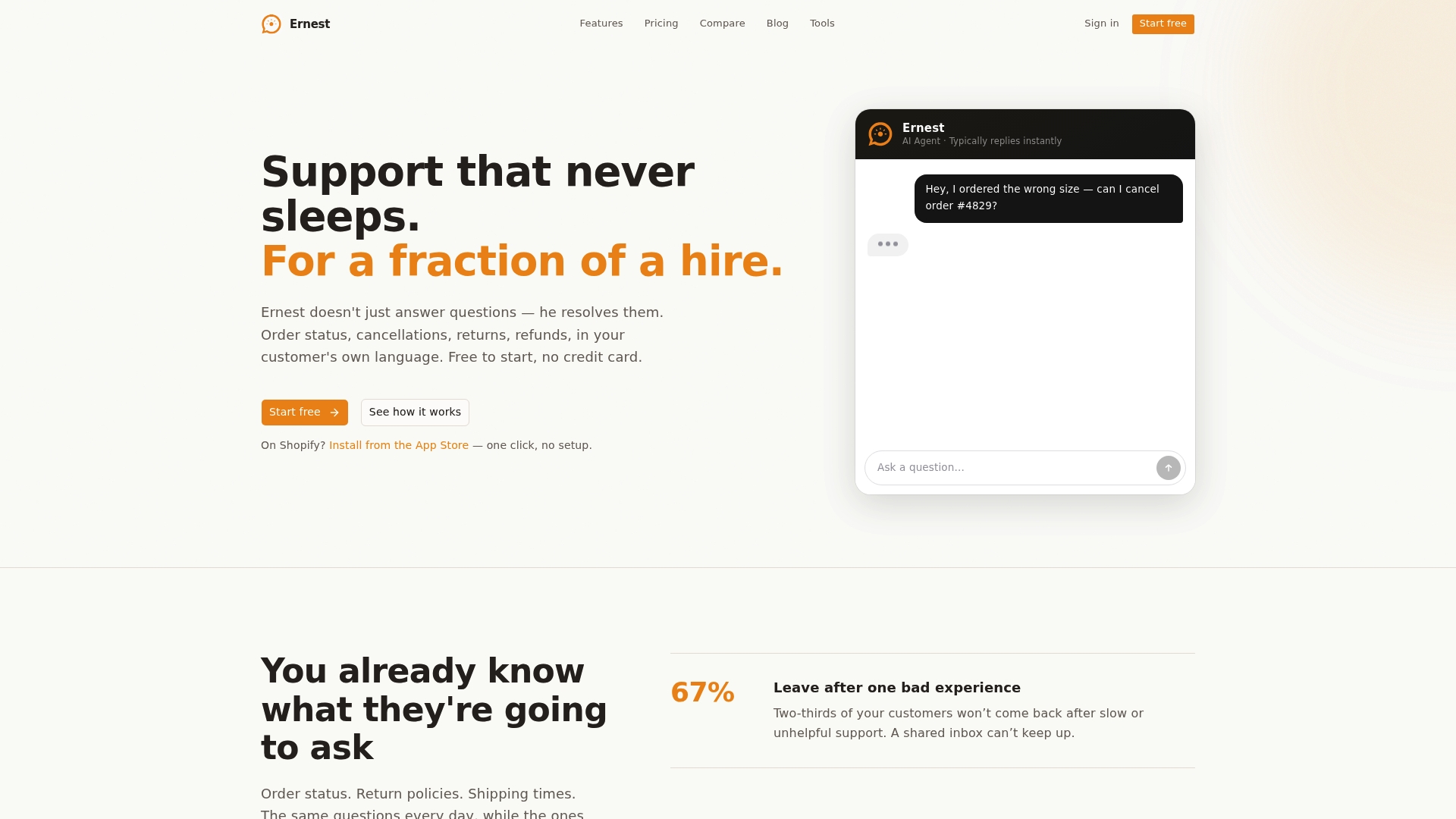
Pricing is transparent and tiered by conversation volume, with a free plan that includes core AI features. No per-seat fees, no AI locked behind an enterprise tier. When a case does need a human, Ernest hands off with full order context so your agent can resolve it in one message.
Check the pricing page to see which plan fits your current volume, or start on the free tier and run your first scripted tests this week.
Sources and further reading
| Source | Best used for |
|---|---|
| 10 Best Zendesk Alternatives Reviewed (The CX Lead) | Market breadth, alternative feature sets, setup time guidance |
| The Best Help Desk Software (Monday.com Blog) | Pricing models, free-tier availability, plan comparisons |
| The Best IT Help Desk Software (PCMag) | AI feature benchmarks, reviewer criteria for automation |
| Best Zendesk Competitors and Alternatives (SolarWinds Blog) | Trust signals (G2, case studies), comparison dimensions |
| 10 Best Help Desk Software (The CX Lead) | Shopify integration as a selection criterion |
| Ernest (Heyernest) | Ernest product features, Shopify integration, action automation |
| Ernest Pricing (Heyernest) | Tier details, free plan, AI feature access by plan |
| Customer Service for Small Business (Ernest Blog) | Implementation guidance, automated action setup |
Recommended
- Best Customer Service Software for Small Business in 2026: A No-Fluff Comparison | Ernest Blog
- Ecommerce Customer Service: What Small Stores Get Wrong (and How to Fix It) | Ernest Blog
- Customer Service Conversation Examples (And What Makes Each One Work) | Ernest Blog
- 30 Customer Service Statistics Small Businesses Should Know in 2026 | Ernest Blog