Gorgias Alternatives for Ecommerce Support Teams: 2026
Explore the top Gorgias alternatives for ecommerce support teams in 2026. Discover tools like Ernest, Zendesk, and Freshdesk tailored to your needs.

If you want predictable costs and a like-for-like swap, start with a seat-priced helpdesk. If your goal is autonomous resolution at scale, pilot an AI-first platform like Ernest before committing to a full migration. That's the fork. Everything else is detail.
Quick shortlist:
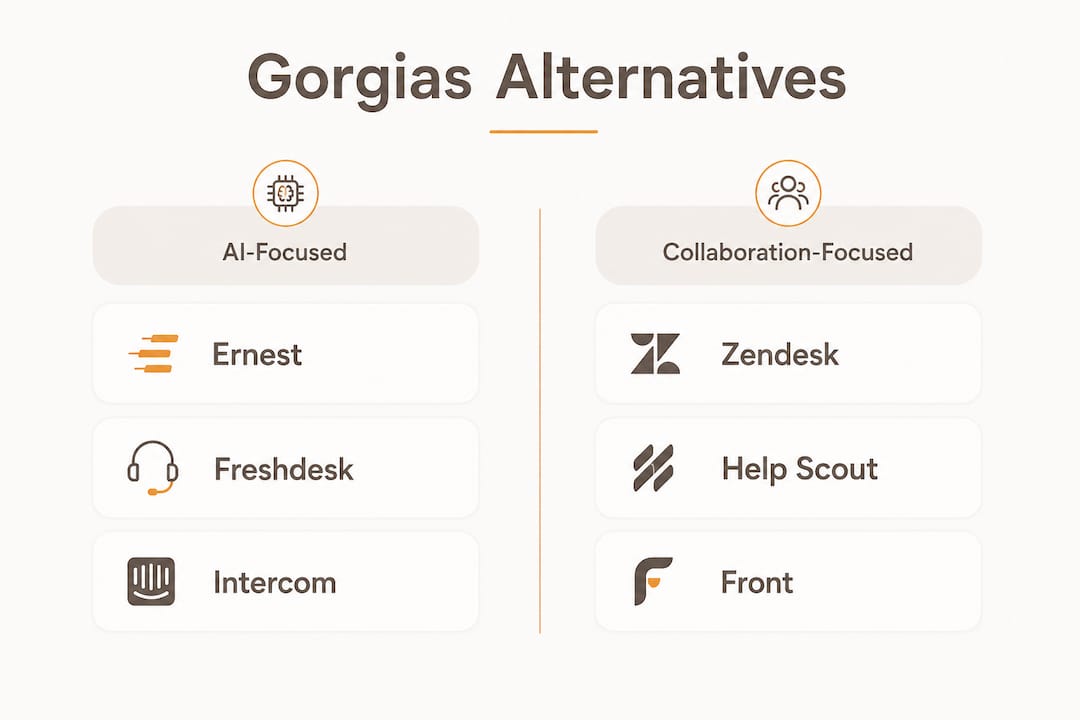
- Ernest — best for AI-first autonomous resolution with predictable, volume-based pricing and native Shopify integration
- Zendesk — best for mid-market and enterprise teams that need deep multi-channel support and mature reporting
- Freshdesk — best for startups and growing teams that want a generous free tier and easy onboarding
- Intercom — best for teams that prioritize proactive messaging and customer relationship depth over ticket-first workflows
- Re:amaze — best for ecommerce brands that want strong live chat and native Shopify/WooCommerce/BigCommerce integrations
- Help Scout — best for email-first teams that value simplicity and a clean, human-feeling inbox
- Zoho Desk — best for mid-to-large teams that want a feature-rich platform at a lower per-seat cost
- Richpanel — best for scaling ecommerce brands that want a customer-facing self-service portal alongside agent tools
- Front — best for collaboration-heavy teams managing shared inboxes across email, SMS, and social
Decision fork in one sentence: if your main complaint is AI accuracy or deflection rate, run a 30-day AI pilot first; if your complaint is pricing shape, missing channels, or the absence of workforce management, plan a migration.
Table of Contents
- How do these Gorgias alternatives compare at a glance?
- Which platform actually fits your team? Short vendor profiles
- How do you pick the right alternative without wasting a quarter?
- Should you upgrade your AI layer or replace the helpdesk?
- Why are teams looking for Gorgias alternatives in the first place?
- Key Takeaways
- The decision most teams get backwards
- Cut response times and costs with Ernest's AI pilot
- Useful sources and further reading
How do these Gorgias alternatives compare at a glance?
| Platform | Best for | Pricing model | Shopify & ecommerce integrations | Automation & AI | Analytics depth | Scalability | Migration difficulty | Free trial / free tier |
|---|---|---|---|---|---|---|---|---|
| Ernest | AI-first autonomous resolution | Conversation volume tiers | Native Shopify; ingests FAQs, policies, product data | End-to-end resolution (order status, returns, cancellations) | Resolution and deflection metrics | Solo founder → mid-market | Low — fast Shopify setup | Free plan available |
| Zendesk | Mid-market → enterprise | Per seat | Shopify app; broad integrations | Bot + deflection; AI add-ons | Deep; custom dashboards | High | Medium-high | 14-day trial |
| Freshdesk | Startups and SMBs | Per seat (free tier available) | Shopify app; WooCommerce | Freddy AI; rule-based automation | Moderate; advanced in paid tiers | Medium | Low-medium | Free tier + 21-day trial |
| Intercom | Relationship-driven CX | Per seat + usage | Shopify; broad CRM integrations | Fin AI agent; proactive messaging | Moderate | Medium-high | Medium | 14-day trial |
| Re:amaze | Ecommerce live chat | Per agent/month | Deep: Shopify, WooCommerce, BigCommerce, refund actions | Rule-based + basic bots | Moderate | SMB → mid-market | Low-medium | 14-day trial |
| Help Scout | Email-first simplicity | Per seat | Shopify via integration | Automated workflows; limited AI | Basic-moderate | SMB | Low | 30-day trial |
| Zoho Desk | Feature-rich at lower cost | Per seat | Shopify app; Zoho ecosystem | Zia AI; automation rules | Good; custom reports | SMB → enterprise | Medium | Free tier + 15-day trial |
| Richpanel | Self-service + agent tools | Per conversation | Deep Shopify/BigCommerce; self-service portal | Rule-based deflection; self-service flows | Moderate | SMB → mid-market | Medium | Demo-based |
| Front | Shared inbox collaboration | Per seat | Shopify via integration | Rule-based; limited native AI | Moderate | SMB → mid-market | Low-medium | 7-day trial |

Pro Tip: Model your peak month before signing any contract. Take your Black Friday or promotional-period conversation volume and multiply it by the per-resolution or per-ticket rate. For a store with 6,000 monthly conversations that spikes notably during a promotion, a per-ticket plan at $0.10/ticket costs substantially more during peak periods. A flat seat-based or conversation-volume-tiered plan caps that exposure.
Buyer-profile pairings:
- Running a lean team (1–4 agents) with high Shopify order-action volume? Re:amaze or Ernest give you the deepest ecommerce-native automation without enterprise overhead.
- Managing 5+ agents across multiple brands with SLA accountability? Zendesk or Zoho Desk give you the reporting and workflow depth to justify the seat cost.
- Primarily email-based with no live chat requirement? Help Scout is the lowest-friction option with the gentlest learning curve.
Which platform actually fits your team? Short vendor profiles

Ecommerce helpdesks fall into a few natural segments: ecommerce-native platforms, CRM-style platforms, SMB chat-first solutions, and AI-native or managed platforms. Knowing which segment a vendor lives in shapes your evaluation before you ever book a demo.
Ernest
Ernest is an AI-first support agent built specifically for ecommerce. It connects to Shopify and ingests your FAQs, return policies, and product catalog so it can resolve order status, return, and cancellation inquiries autonomously, 24/7. Refunds are routed to you for one-click approval, and complex cases escalate to agents with full context already attached.
Pros:
- Resolves common ecommerce inquiries end-to-end, not just deflects them
- Transparent conversation-volume pricing with AI included across all tiers
- Fast setup: no lengthy configuration before it starts handling tickets
- Multilingual support out of the box
Cons:
- Not a full-featured helpdesk with built-in WFM or voice channels
- Best fit when Shopify is your primary commerce platform
- Reporting centers on resolution and deflection metrics rather than deep agent analytics
Pricing snapshot: Free plan available; paid tiers scale by conversation volume with no per-seat charges. AI features are included at every tier, not locked behind an add-on.
Who should pick this: Teams whose primary problem is response time and AI deflection rate, not missing channels. If you want to test autonomous resolution before committing to a platform migration, Ernest is the lowest-friction pilot available.
Zendesk
Zendesk is the enterprise-grade multi-channel helpdesk. It handles email, chat, voice, social, and SMS in one place, with mature SLA management, custom reporting, and a large app marketplace.
Pros:
- Deep reporting and custom dashboards for unit-economics visibility
- Native SLA management and audit logs
- Broad integration library including Shopify
Cons:
- Pricing starts at $49 per agent/month and climbs quickly with add-ons
- Steep learning curve; teams often need regular training to keep up with updates
- AI capabilities require additional spend beyond the base seat cost
Pricing snapshot: Per-seat billing starting at $49/agent/month. No free tier; 14-day trial available.
Who should pick this: Mid-market and enterprise teams that need mature SLA tracking, deep analytics, and multi-channel coverage across voice and social.
Freshdesk
Freshdesk is the friendliest on-ramp for teams new to helpdesk software. Its interface is clean, automation rules are easy to configure, and the free tier is genuinely useful for small teams.
Pros:
- Free tier available; 21-day trial on paid plans
- Freddy AI for chatbot deflection and suggested replies
- Omnichannel routing and SLA management on paid tiers
Cons:
- Advanced analytics and AI features are locked behind higher-priced plans
- Shopify integration is functional but not as deep as ecommerce-native platforms
- Can feel limiting once a team scales past basic ticket routing
Pricing snapshot: Free tier for up to 10 agents; paid plans start at $15/agent/month. Freddy AI costs extra on most plans.
Who should pick this: Startups and early-stage ecommerce teams that want a low-risk entry point with room to grow.
Intercom
Intercom is built around the customer relationship, not the ticket. Its Fin AI agent can handle complex conversational flows, and its proactive messaging tools let you reach customers before they file a ticket.
Pros:
- Fin AI agent handles nuanced conversations, not just FAQ deflection
- Proactive in-app and email messaging to reduce inbound volume
- Strong CRM-style customer timeline across Shopify and other integrations
Cons:
- Pricing combines per-seat and usage charges, which creates the same peak-month exposure as per-ticket models
- Heavier to configure than simpler helpdesks
- Better suited to SaaS-style CX than pure order-management workflows
Pricing snapshot: Per-seat base plus usage-based AI resolution fees. 14-day trial available.
Who should pick this: Teams that want to blend proactive messaging with reactive support and are comfortable with variable monthly costs.
Re:amaze
Re:amaze was designed for online stores. It integrates deeply with Shopify, WooCommerce, and BigCommerce, and agents can issue refunds and check order details without leaving the inbox.
Pros:
- Deep ecommerce integrations including in-ticket refund actions
- Strong live chat with canned responses and automation rules
- Affordable entry price for small teams
Cons:
- Per-agent pricing starts at $29/agent/month, which adds up for larger teams
- Bot capabilities are rule-based rather than generative AI
- Email handling has some gaps (limited BCC support, no classic forward)
Pricing snapshot: Per-agent/month billing starting at $29. No free tier; 14-day trial available.
Who should pick this: Small-to-medium ecommerce brands that live in Shopify and want strong live chat without paying enterprise prices.
Help Scout
Help Scout keeps things simple. Two native channels (email and live chat), a clean shared inbox, and a customer-first philosophy that makes it easy to onboard new agents fast.
Pros:
- Intuitive interface with minimal training required
- 30-day free trial, one of the longest in the category
- Integrates with Mailchimp, Salesforce, and Slack
Cons:
- Limited to email and live chat natively; voice and social require add-ons
- AI and automation features are basic compared to ecommerce-native platforms
- Not built for high-volume order-action workflows
Pricing snapshot: Per-seat billing; 30-day trial available. Pricing not publicly listed for all tiers.
Who should pick this: Email-first support teams that want a clean, human-feeling inbox and don't need deep Shopify order actions.
Zoho Desk
Zoho Desk packs a lot of features into a competitive price point. Its Zia AI handles ticket tagging, sentiment analysis, and suggested replies. It fits well inside the broader Zoho ecosystem (CRM, analytics, inventory).
Pros:
- Competitive pricing: entry plans start at $14/agent/month
- Zia AI included in mid-tier plans
- Strong omnichannel support and custom reporting
Cons:
- Zia AI requires the $40/agent/month plan
- Interface can feel complex for teams outside the Zoho ecosystem
- Shopify integration exists but is not as deep as ecommerce-native tools
Pricing snapshot: Per-seat billing starting at $14/agent/month; Zia AI available at $40/agent/month. Free tier available; 15-day trial on paid plans.
Who should pick this: Mid-to-large teams that want a feature-rich platform at a lower per-seat cost, especially if they already use other Zoho products.
Richpanel
Richpanel gives customers an Amazon-style self-service portal where they can check order status, initiate returns, or cancel without ever contacting an agent. That deflection layer is its strongest differentiator.
Pros:
- Customer-facing self-service portal reduces inbound ticket volume
- Deep Shopify and BigCommerce integrations
- Unified omnichannel inbox for agents
Cons:
- Per-conversation pricing creates the same peak-month exposure as Gorgias
- Best suited to stores with 500+ monthly tickets; lighter-volume stores may not see ROI
- Demo-based onboarding; no self-serve free trial
Pricing snapshot: Per-conversation billing. Pricing not publicly listed; demo required.
Who should pick this: Scaling ecommerce brands that want to deflect order-status tickets through self-service before they ever reach an agent.
Front
Front is a shared inbox platform built for collaboration. Teams manage personal and shared inboxes, email, SMS, and social channels in one place, with strong internal commenting and assignment workflows.
Pros:
- Excellent for teams that handle complex, multi-touch conversations
- Clean interface with fast setup
- Integrates with Shopify via third-party connections
Cons:
- Not built for ecommerce order actions natively
- AI capabilities are limited compared to purpose-built ecommerce tools
- Per-seat pricing can get expensive for larger teams
Pricing snapshot: Per-seat billing; 7-day trial available. Pricing not publicly listed for all tiers.
Who should pick this: Teams where internal collaboration and shared inbox management matter more than deep Shopify order-action automation.
Worked cost example: A store with 4 agents and 6,000 monthly conversations pays an amount on a seat-based plan that remains stable month to month, while per-ticket pricing can cost multiple times more during peak periods such as Black Friday spikes. The seat-based plan stays flat. That gap is why per-ticket billing consistently changes vendor decisions once teams model their peak month.
Pro Tip: When evaluating migration effort, map three artifact sets before you start: macros and templates, Shopify order-action mappings, and your KB/FAQ content. Vendors that offer a one-click Gorgias import cut migration time significantly. Ask about this in your first demo.
How do you pick the right alternative without wasting a quarter?
Start with two questions before you open a single demo link. First: do you need native in-ticket order actions (refunds, cancellations, subscription edits) directly from the helpdesk? If yes, your shortlist is limited to ecommerce-native platforms. Second: is your pricing pain driven by seasonal volume spikes? If yes, eliminate any per-ticket or per-resolution vendor immediately.
Procurement checklist
- Define your non-negotiables. List the channels you actually use (email, chat, voice, social), the order actions agents perform daily, and whether you need built-in WFM or QA tools.
- Model your peak month. Take your highest-volume month and run the numbers under each pricing model. A plan that looks cheap in February may be your biggest line item in December.
- Request a data migration walkthrough. Ask the vendor: Can you export macros and templates in a portable format? Do you have a Gorgias import tool? How long does KB migration take?
- Ask about AI grounding. How does the AI stay current when your return policy changes? How often is the knowledge base refreshed? What happens when the AI is wrong?
- Check SLA and uptime commitments. Gorgias lacks native SLA management, so if that's a gap you're filling, confirm the alternative handles it natively, not through a third-party app.
- Verify reporting exports. Can you pull raw ticket data, resolution rates, and handle times into your BI tool? Platforms that lock core reporting behind expensive add-ons are harder to justify to finance teams.
- Test escalation paths. For AI-first tools, submit edge-case tickets during your trial and measure how cleanly the handoff to a human agent works.
Hard red flags
- Opaque AI pricing with no clear per-resolution or volume cap
- No exportable macros or templates (you'll rebuild everything from scratch)
- Missing audit logs (a compliance and accountability gap)
- Weak SLA commitments or no uptime guarantee in writing
- Reporting locked entirely behind the highest pricing tier
Realistic timeline
A typical pilot runs 2–4 weeks. A full migration, including data export, KB rebuild, and agent training, usually takes 4–8 weeks depending on ticket volume and integration complexity. Budget one dedicated resource (a support ops lead or a technical project manager) for the migration sprint. Trying to run it alongside normal support operations without dedicated capacity is the most common reason migrations stall.
Pro Tip: Build a numbered trial checklist before you start: (1) connect your Shopify store, (2) import your top 20 macros, (3) run 100 live tickets through the new system, (4) measure first-response time and resolution rate against your current baseline, (5) check escalation quality on 10 edge cases. That five-step sequence tells you more than any demo.
Should you upgrade your AI layer or replace the helpdesk?
The answer depends on which problem you're actually solving. If agents are complaining that the AI gives wrong answers or misses ticket types, that's an AI accuracy problem. A structured 30-day pilot fixes it without touching your helpdesk infrastructure. If the complaint is that your bill spikes every November, or that you're missing voice support, or that your WFM tool is a separate subscription, those are platform problems. A pilot won't fix them.
Built-in workforce management and analytics are increasingly cited as reasons teams leave Gorgias, because reducing tool sprawl matters to finance teams that review the full software stack.
30-day AI pilot plan
- Week 1 — Baseline. Measure your current resolution rate, deflection rate, escalation rate, cost per resolution, average handle time, and CSAT. These are your gates.
- Week 2 — Configuration. Connect the AI to your Shopify store, upload your FAQ and return policy, and define the ticket types you want it to handle autonomously. Start with order status and returns only.
- Week 3 — Live sampling. Route 20–30% of inbound tickets through the AI. Monitor for precision (correct resolutions) and recall (what percentage of resolvable ticket types the AI actually handles). Track escalation friction: how long does handoff take, and does the agent receive full context?
- Week 4 — Decision gate. If resolution rate meets your threshold and escalation friction is low, expand the AI's scope. If accuracy is below target, identify the knowledge gaps and decide whether a second configuration sprint is worth it or whether the platform itself is the constraint.
Success thresholds to set before you start: resolution rate target, maximum acceptable escalation rate, CSAT floor, and cost-per-resolution ceiling. Without pre-defined gates, pilots drift into indefinite evaluation.
The success tax pattern is worth modeling during the pilot too. If your current platform charges per ticket, calculate what your pilot month would have cost under a flat or volume-tiered plan. That comparison often makes the migration decision obvious.
Ernest is built for exactly this pilot structure. It connects to Shopify, ingests your existing FAQs and policies, and starts resolving order status, returns, and cancellation requests autonomously from day one. Because pricing is tied to conversation volume rather than per-resolution fees, you can model your peak-month exposure before you commit.
Pro Tip: Measure both precision and recall during your pilot, not just resolution rate. A bot that resolves 80% of the tickets it attempts but only attempts 40% of your ticket types has a recall problem. You need both numbers to know whether the AI layer is actually working.
Why are teams looking for Gorgias alternatives in the first place?
Gorgias built its reputation on deep Shopify integration. Agents can check order status, issue refunds, and edit orders without leaving the inbox, and for small stores with heavy order-action workflows, that's genuinely hard to replicate. But several friction points push teams to look elsewhere as they grow.
The most common trigger is the per-ticket pricing model. Gorgias charges by ticket volume, which means costs spike exactly when business is best. A G2 reviewer noted the base price is manageable but becomes "a little on the higher price point when it comes to the automation add-ons." Teams that run seasonal promotions or Black Friday campaigns often discover their support bill doubled without any change in team size.
Reporting is a second friction point. Gorgias limits historical data retention to 90 days, which makes year-over-year comparisons impossible and frustrates data-driven support leaders who need to show unit economics to finance. As one G2 reviewer put it, "reporting only allows for historical data within 90 days."
A third issue is scalability. Gorgias is purpose-built for small-to-medium ecommerce operations. Teams that grow past that range often find they're missing native SLA management, advanced WFM, and the kind of enterprise-grade reporting that justifies the tool to a broader organization. As one reviewer noted on G2, "If you're looking for anything outside an e-commerce scope, you'll want to skip Gorgias and check out broader solutions."
Mobile reliability rounds out the list. The Android app has been reported to crash randomly, and the iOS version draws consistent criticism, which is a real problem for support leads who need to monitor queues on the go.
None of these are reasons to panic-migrate. But if two or more of them describe your situation right now, you're in the right place to evaluate your options.
Key Takeaways
The single most important decision in this evaluation is the fork: fix the AI layer first, or plan a migration. Getting that wrong wastes months.
| Point | Details |
|---|---|
| Model your peak month first | Run your Black Friday volume through each pricing model before shortlisting; per-ticket plans can cost 2.5x more during spikes. |
| Fix AI before migrating | If the complaint is AI accuracy, a 30-day structured pilot resolves it faster than a full platform switch. |
| Match pricing shape to your growth pattern | Seat-based plans give cost predictability; per-resolution plans reward low volume but punish seasonal spikes. |
| Migration needs three artifact maps | Export macros, Shopify order-action mappings, and KB content before you start; missing one adds weeks to the timeline. |
| Ernest for AI-first pilots | Ernest integrates with Shopify, resolves order status and returns autonomously, and prices by conversation volume with no per-resolution fees. |
The decision most teams get backwards
Most ecommerce support leaders I see evaluating this decision start by comparing feature lists. That's the wrong starting point. The real question is: what's the actual source of your pain?
If your agents are frustrated with AI quality, a platform migration won't fix it. You'll spend 6–8 weeks migrating and end up with the same deflection problem on a different platform. A focused AI pilot, with pre-defined accuracy gates and a clear decision point at day 30, is faster and cheaper than any migration project.
If the pain is pricing shape, specifically the way costs spike during your best months, then no amount of AI tuning on your current platform solves it. That's a structural problem, and it requires a structural fix: moving to a seat-based or volume-tiered plan where your bill doesn't punish you for running a successful promotion.
The platforms that tend to win long-term aren't necessarily the ones with the longest feature list. They're the ones where the pricing model matches how the business actually grows, where reporting gives finance teams the visibility they need, and where the AI layer can be trusted to handle the repetitive work without constant babysitting. Those three things together are harder to find than any individual feature.
Cut response times and costs with Ernest's AI pilot
If you've read this far and the AI-first path makes sense for your team, Ernest is worth a serious look. It connects directly to Shopify, pulls in your FAQs, return policies, and product data, and starts resolving order status, return, and cancellation requests autonomously from day one. No lengthy configuration sprint. No per-resolution fees that spike during your busiest months.
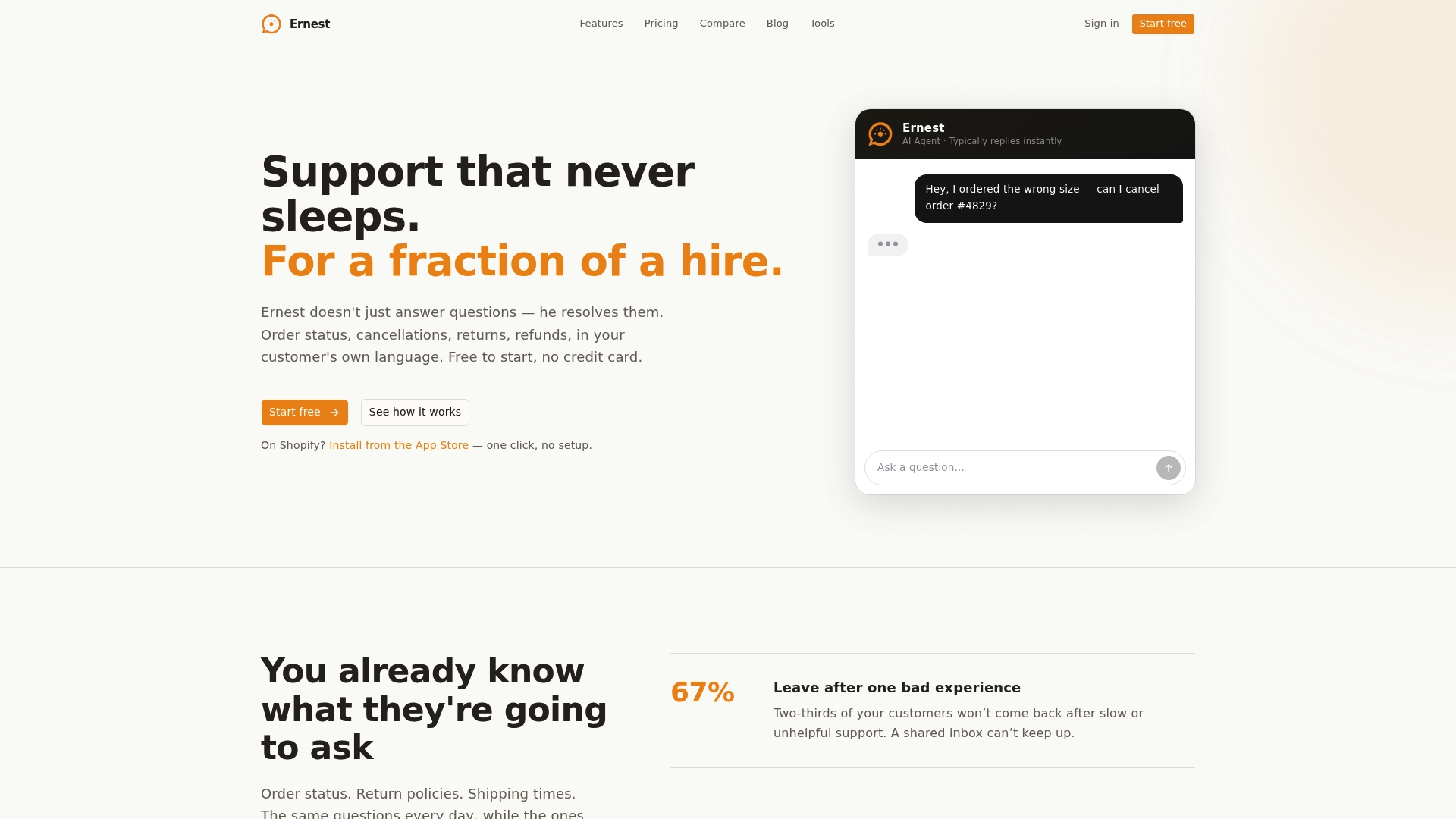
The free plan lets you test the core resolution flow before you spend anything. Paid tiers scale by conversation volume, so you can model your peak-month exposure upfront and know exactly what you're committing to. AI features are included at every tier, not locked behind an add-on. If you want to run a structured 30-day pilot with clear metrics before making any platform decision, start with Ernest and see what autonomous resolution actually looks like for your store.
Useful sources and further reading
| Source | Best for | Type |
|---|---|---|
| G2 Gorgias reviews | Real user pain points, pricing complaints, mobile issues | User reviews |
| HelpSpot: Gorgias Competitors | Seat vs. per-ticket pricing comparison, multi-brand support | Pricing analysis |
| Kustomer: Top Gorgias Alternatives | Broad vendor landscape, SLA gaps, success tax framing | Vendor comparison |
| Enchant: 8 Best Gorgias Alternatives | SMB-focused shortlist with integration notes | Vendor comparison |
| Tidio: Top 10 Gorgias Alternatives | Quick comparison table with ratings and free-plan flags | Vendor comparison |
| DragApp: Best Gorgias Alternatives | Peak-month cost modeling, success tax math | Pricing analysis |
| GetMacha: Best Gorgias Competitors | Ecommerce helpdesk category mapping | Market overview |
| BlueTweak: Gorgias Alternatives | WFM, QA, and analytics feature comparison | Feature analysis |
| Ernest: customer service software comparison | Pricing model shapes for small businesses | Internal reference |
| Ernest: ecommerce customer service mistakes | Operational gaps to fix during migration or pilot | Internal reference |