Best Drift Alternatives for Ecommerce Stores in 2026
Drift is built for marketing chat. If most of your volume is order status, cancellations and returns, here are the support-first alternatives to test.

For Shopify stores focused on order status, cancellations, and returns, Ernest is the top Drift alternative. It's Shopify-native, support-first, and priced by conversation volume rather than per seat.
After Salesloft's acquisition of Drift, the roadmap shifted toward revenue orchestration rather than standalone conversational AI, leaving e-commerce teams shopping for a replacement that actually handles transactional support. Here's a quick shortlist by store profile:
- Solo founders and small stores: Ernest (free plan, fast Shopify setup, automated returns and cancellations)
- High-volume stores needing ticketing: Gorgias or Zendesk (ticketing-heavy, per-seat pricing)
- Teams wanting blended support and marketing chat: Intercom (broader platform, higher cost)
- Budget-first chat with basic automation: Tidio (low entry price, lighter AI)
If your chat queue is mostly "Where's my order?" and "Can I cancel this?", a purpose-built support agent beats a marketing chat platform every time.
Table of Contents
- How do the best drift alternatives compare for e-commerce support?
- How do you pick the right Drift alternative for your store?
- What does a safe migration from Drift actually look like?
- Key Takeaways
- When should you choose a purpose-built support agent over a marketing chat platform?
- Ernest handles the support work your store actually needs
- Useful sources and further reading
How do the best drift alternatives compare for e-commerce support?
The table below maps four practical vendor categories against the dimensions that matter most for transactional support. Ernest is the named recommendation; the others use generic labels.
| Category | Best for | Pricing model | Shopify integration | Automation (order status, cancellations, returns) | Setup time | Human handoff | Scales for high volume? |
|---|---|---|---|---|---|---|---|
| Support-first AI agent (Ernest) | Solo founders to mid-market Shopify stores | Conversation-volume tiers; free plan available | Native Shopify app | Full: order lookups, cancellations, return initiation | Hours to 1 day | Context-preserving escalation to human agents | Yes |
| Commerce-native helpdesk (e.g., Gorgias) | High-volume stores needing ticketing + macros | Per-ticket or per-seat | Native Shopify app | Partial: macros and rules, less autonomous AI | 1–3 days | Ticket-based; strong agent workspace | Yes, at higher cost |
| Full support platform (e.g., Intercom, Zendesk) | Mid-market to enterprise, mixed support and sales | Per-seat + AI resolution add-ons | Plug-in / API | Moderate: AI agents available but not support-first | 2–6 weeks for enterprise | Broad; omnichannel | Yes |
| Budget chat app (e.g., Tidio, Ada) | Small stores, early-stage founders | Flat monthly tiers | Plug-in or native | Basic: rule-based flows, limited order data access | Same day | Basic; limited context | Limited |
Specialized AI agents trained on a store's own policies and order data resolve transactional requests more reliably than general-purpose chatbots. That's the core reason Ernest leads this list for stores where support is the primary job.
Why Ernest wins for most Shopify stores: It ingests your FAQs, return policies, and live order data on day one, answers in minutes 24/7, and hands off to a human with full context when something genuinely needs a person. No developer required.
How do you pick the right Drift alternative for your store?
The single most important factor is fit to your primary job. If transactional support (order lookups, cancellations, return requests) makes up the majority of your chat volume, you need a support-first agent, not a marketing chat platform. Shopify-native integration and simplicity of support workflows predict long-term satisfaction more reliably than a deep feature list.
Evaluation criteria to run through:
- Native Shopify app. Does it connect without custom API work? If you lack engineering bandwidth, a native app cuts hidden development costs and shortens time-to-live dramatically.
- Automation depth. Can it resolve order status, cancellations, and returns on its own, or does it only route tickets?
- Pricing model. Conversation-volume plans suit high-traffic stores better than per-seat pricing. Use the Erlang C staffing calculator to estimate how many conversations you're handling and what that costs under each model.
- Handoff and context preservation. When the AI escalates, does the human agent see the full conversation and order data, or does the customer have to repeat themselves?
- Data residency and US compliance. Confirm where conversation data is stored and whether the vendor meets your data retention requirements.
- Support SLAs. What is the vendor's own response time when you need help?
- Scalability. Can the platform handle your peak (Black Friday, a viral product drop) without degrading?
Questions to ask in a 15-minute vendor call:
- Does your Shopify app pull live order data, or does it rely on a nightly sync?
- Can the agent autonomously cancel an order or initiate a return, or does it just surface a link?
- How is pricing calculated when conversation volume spikes 3x during a sale?
- What does the human handoff look like? Does the agent pass full order context?
- Where is conversation data stored, and what's your data retention policy?
Pricing example: A mid-volume store handling 2,000 support conversations per month pays very differently under per-seat versus conversation-volume pricing. Two support agents on a $55/seat platform costs $110/month before any AI add-ons. A conversation-volume plan covering 2,000 conversations may cost less and includes AI across all tiers. The cheapest listed plan often becomes the most expensive once you factor in integration work and developer hours for API-only tools.
Red flags to watch for:
- Hidden integration fees or "setup packages" not listed on the pricing page
- No native Shopify app (API-only means developer time and ongoing maintenance)
- Poor handoff context, so the human agent starts cold with no order data
- Inconsistent escalation logs that make it hard to audit what the AI said
What does a safe migration from Drift actually look like?
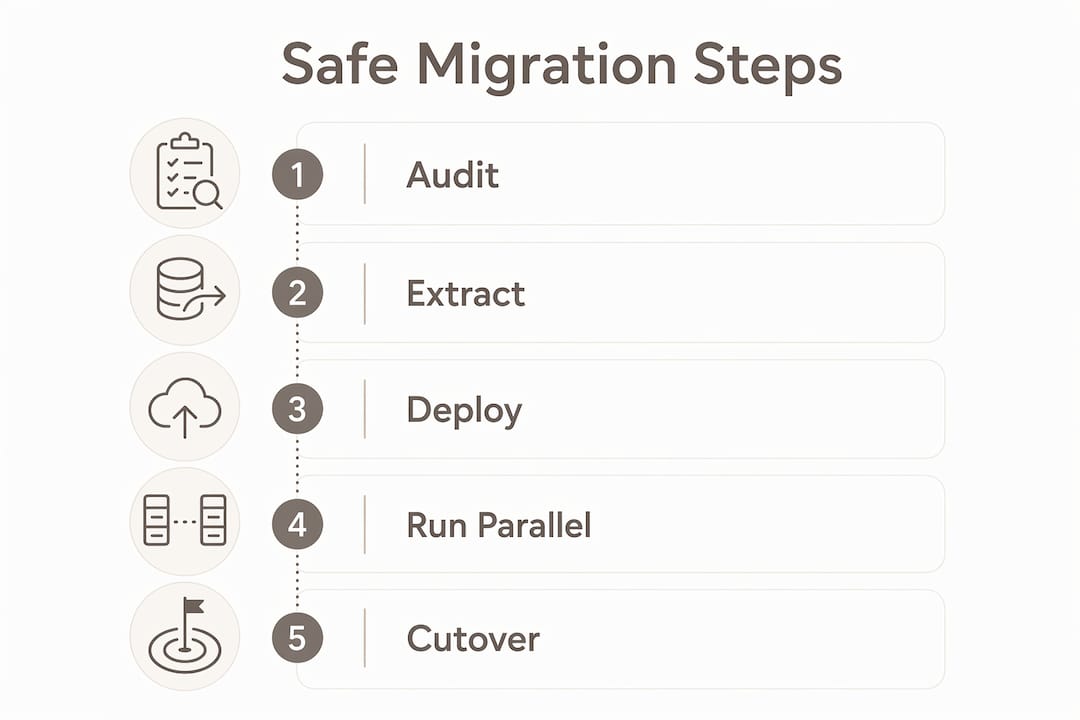
The fastest safe path is a pilot-parallel run, not a rip-and-replace. Keep Drift live while you deploy the new agent in a sandbox, test it against real order data, and only cut over once it's passing your test cases.
Step 1: Audit your Drift playbooks and routing rules. Document every playbook, routing tree, and CRM field mapping before you touch anything. Migrating off Drift means moving routing logic and CRM field mappings, not only the chat widget. Skip this step and you get attribution breakage and lost pipeline context.
Step 2: Extract CRM field mappings and order data endpoints. List every field Drift writes to your CRM (contact owner, lead source, conversation ID) and map them to the new platform's schema. Do the same for order data connections.
Step 3: Deploy the new agent in sandbox. Connect it to Shopify, ingest your FAQs and return policy, and run it against a test product catalog before any customer sees it.
Step 4: Run parallel. Route a small slice of live traffic to the new agent while Drift handles the rest. This is your safety net.
Step 5: Cutover. Once test cases pass and parallel metrics look good, flip the switch during a low-traffic window (Tuesday morning, not the day before a sale).
Test cases to run before go-live:
- Order status lookup using a real order number
- Cancellation workflow for an order within the cancellation window
- Return initiation for an out-of-window request (tests policy enforcement)
- Human handoff continuity: confirm the agent passes full context to the human queue
Migration metrics to track:
| Metric | Target range | Notes |
|---|---|---|
| Time-to-resolution | Under 3 minutes for automated flows | Benchmark against your Drift baseline |
| Deflection rate | majority for transactional queries | Higher is better; track by query type |
| Escalation rate | low | Flag if this rises post-migration |
| Misattribution rate | very low | Audit CRM records weekly for the first month |
Pro Tip: Audit your routing logic and CRM data-mapping schema before you pick a cutover date. Teams that skip this step routinely discover broken attribution two weeks after go-live, when it's much harder to fix.
Key Takeaways
For e-commerce stores replacing Drift, a support-first AI agent with native Shopify integration and conversation-volume pricing delivers faster order resolutions, fewer escalations, and more predictable costs than a marketing-focused chat platform.
| Point | Details |
|---|---|
| Support-first fit matters most | Choose a tool built for transactional queries (order status, cancellations, returns) rather than one adapted from marketing chat. |
| Native Shopify integration saves money | API-only tools carry hidden developer costs; a native app cuts setup time to hours and reduces ongoing maintenance. |
| Audit before you migrate | Map routing logic and CRM fields before cutover to avoid attribution breakage and lost order context. |
| Conversation-volume pricing fits stores better | Per-seat models cost more at scale; volume-based plans stay predictable even during traffic spikes. |
| Ernest is the recommended starting point | Ernest offers a free plan, native Shopify setup, and automated order/return handling with context-preserving human handoff. |
When should you choose a purpose-built support agent over a marketing chat platform?
Pick a purpose-built support agent when transactional support makes up the majority of your chat volume. Below that threshold, a blended platform might cover both jobs adequately. Above it, a marketing-oriented tool will frustrate customers and create more escalations than it prevents.
Consider two scenarios. A solo founder running a high-return-rate apparel store gets the most value from an agent that autonomously handles return requests, checks order eligibility against policy, and escalates only the edge cases. A mid-market storefront with mixed traffic (some support, some product discovery, some upsell) might reasonably run a blended platform that handles both, accepting slightly lower resolution rates on transactional queries in exchange for a unified inbox.
The cost and maintenance tradeoff is real: purpose-built support agents tend to have lower total cost of ownership for support-heavy stores, but if you genuinely need marketing automation and support in one tool, you'll pay a premium for the blended platform and accept more configuration work long-term.
Ernest handles the support work your store actually needs
Most Shopify stores don't need a marketing chat platform. They need something that answers "Where's my order?" at 2 AM, processes a return without a ticket queue, and hands off to a human with the full order pulled up rather than a blank screen.
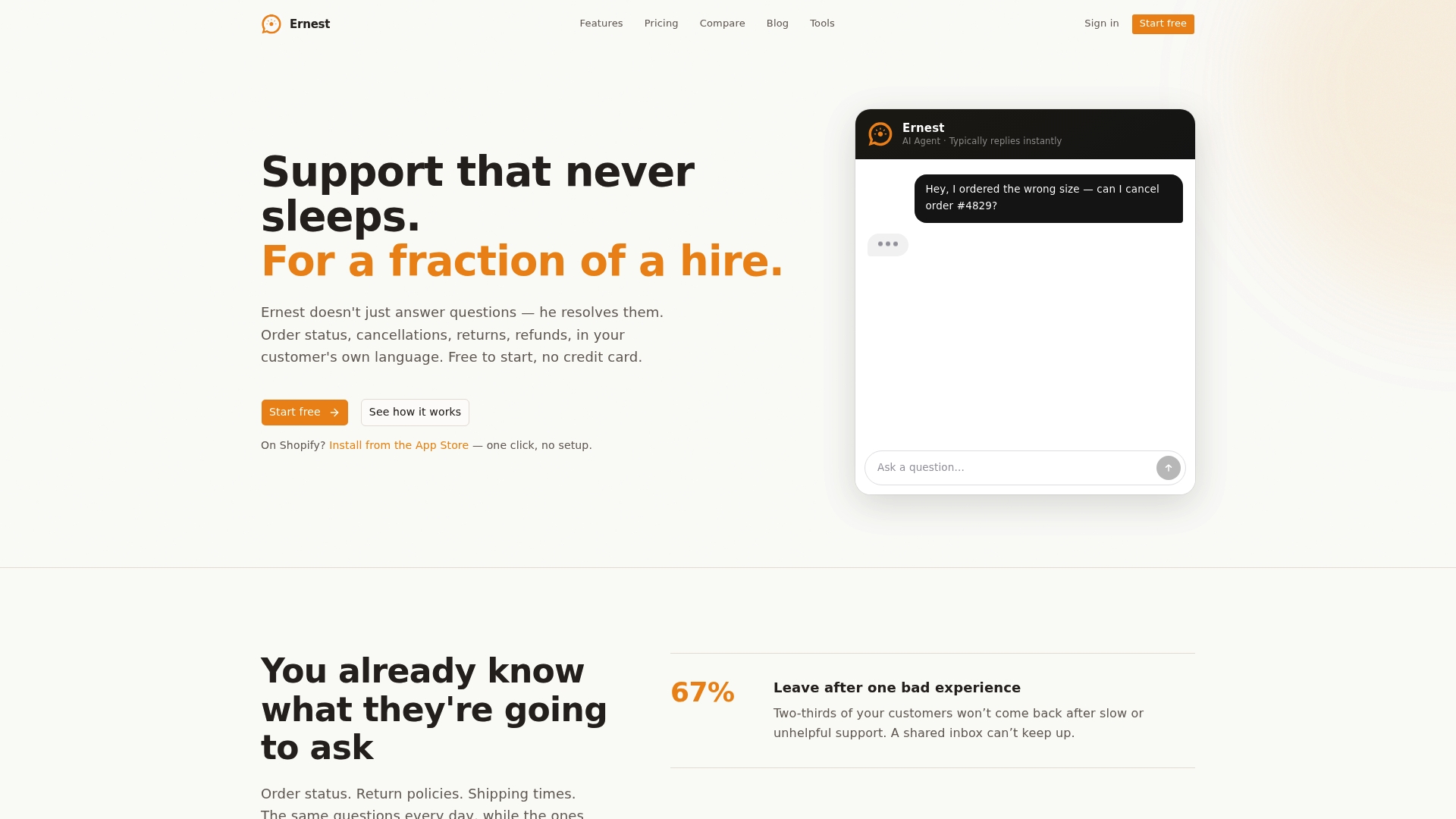

Ernest does exactly that. It connects to Shopify in hours, ingests your return policy and FAQs on day one, and resolves order status, cancellations, and returns autonomously around the clock. Pricing is based on conversation volume, so costs stay predictable whether you're running 500 conversations a month or 5,000. There's a free plan to start, and paid tiers add custom branding and white-labeling for agencies. Start with Ernest and see how quickly your first automated resolution happens.
Useful sources and further reading
These are the primary sources behind the claims in this article. Use them to verify specifics and go deeper on migration, pricing, and integration details.
- Why stores are leaving Drift: Dashly's 2026 Drift alternatives overview covers the Salesloft acquisition context and cost-driver analysis for e-commerce teams.
- Shopify integration and simplicity research: Spike's Drift alternatives guide explains why native integration predicts satisfaction better than feature count, and flags hidden API costs.
- Purpose-built AI agents vs. general chatbots: 11x.ai's alternatives guide covers the shift toward specialized agents trained on store data.
- Migration routing and CRM mapping: SalesPeak's post-acquisition analysis is the clearest practitioner warning on what breaks during migration.
- Setup time benchmarks: WiserReview's audit of seven Drift alternatives covers time-to-value ranges from same-day to six weeks.
- Ernest staffing and cost tools: The Erlang C staffing calculator helps you estimate conversation volume and compare pricing models before committing.
- Common e-commerce support mistakes: The Ernest blog on ecommerce customer service covers what small stores get wrong and how specialized agents fix it.
Run the vendor question checklist from the selection section above on every sales call. The answers will tell you more than any feature comparison page.